In short
- Share of voice is your brand's share of the visibility in a market, compared with your competitors. Each channel measures it differently: ad spend, impression share, mentions or rankings.
- In affiliate-driven categories, buyers compare brands on review and comparison pages. Share of voice there comes down to two things: whether a page lists you, and how high.
- Measure it as coverage (pages listing you divided by pages ranking) plus your average position on those pages, for each keyword and market, every week.
What is share of voice?
Share of voice (SOV) is the share of the visibility in a market that goes to your brand, compared with everyone competing for the same attention. It started as an advertising metric: your ad spend or impressions as a percentage of all the spend or impressions in your category.
The idea now applies to every channel, and each one measures it from its own data:
- Paid media: your share of total category ad spend or ad impressions.
- Paid search: impression share, meaning the percentage of eligible searches where your ad appeared.
- Social and PR: your share of brand mentions in your category.
- Organic search: your share of the clicks available from the keywords you track, usually estimated from rankings.
They all ask the same question: of all the chances a buyer had to see a brand like yours, how many showed them yours?
Share of voice vs share of search
The two terms are often mixed up, but they measure different things.
Share of search is the number of searches for your brand name as a share of the searches for all brand names in your category. It reflects demand that already exists: people who know your brand and look it up. Marketers use it as an early signal of market share.
Share of voice measures visibility you have to earn or buy: whether your brand is in front of people who haven't decided yet.
Someone searching "best online casino uk" hasn't picked a brand, so they add nothing to anyone's share of search. Whether your brand is on the pages they read next decides your share of voice for that search.
Why affiliate pages need their own measure
In casino and betting, trading, credit cards, insurance and software, the top Google results for "best", "top" and "compare" searches are mostly affiliate and review pages. Each one is a ranked list of brands.
That changes what visibility means. Ranking your own website for "best online casino" is hard and often impossible. Being listed on the pages that do rank is how most brands reach those buyers. The usual tools don't capture it:
- Rank trackers show where your own website ranks, not whether the pages above it list you.
- Mention monitoring counts mentions anywhere on the web, but not which of the pages ranking for your keyword list you, or how high.
- Ad-based share of voice leaves out organic comparison pages entirely.
So share of voice on affiliate pages needs two inputs: presence (are you on the page?) and prominence (where are you on its list?).
How to calculate it
Work out two numbers for each keyword in each market.
Coverage
Coverage = pages that list your brand ÷ review and comparison pages ranking for the keyword × 100
If 16 of the top 20 results for a keyword are review or comparison pages and 11 of them list your brand, your coverage is 11 ÷ 16 = 69%.
Average position
Average position = the average of your position on each page's list, counting only the pages that list you
Being seventh on a list is not the same as being first. Readers scan the top of a list, and many never get past the first few brands.
Compare with your competitors
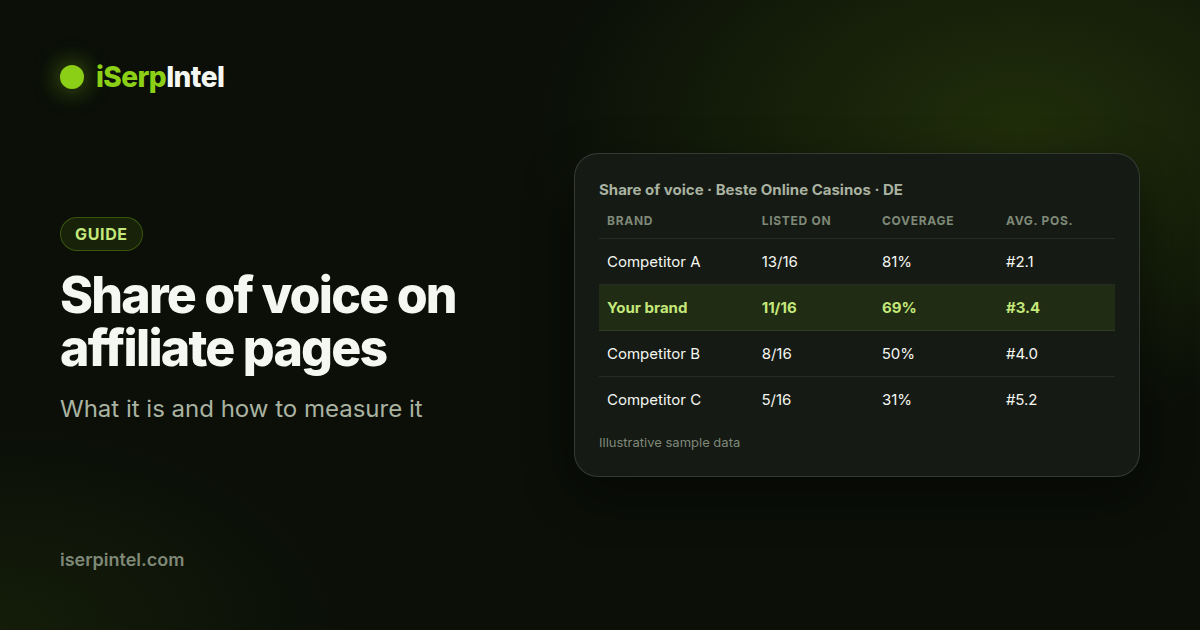
Work out the same two numbers for each competitor, on the same set of pages. The comparison is what makes the numbers useful.
| Brand | Listed on | Coverage | Avg. pos. |
|---|---|---|---|
| Competitor A | 13/16 | 81% | #2.1 |
| Your brand | 11/16 | 69% | #3.4 |
| Competitor B | 8/16 | 50% | #4.0 |
| Competitor C | 5/16 | 31% | #5.2 |
Here your coverage is respectable, but Competitor A is on two more pages and usually listed above you. Those two missing pages, and the pages where A sits higher, are where to look first.
Optional: weight it by traffic
Not every page is worth the same: the page ranking first gets far more visitors than the one ranking twentieth. To allow for that, estimate each page's traffic (the keyword's search volume multiplied by a typical click-through rate for the page's ranking position). Then divide the traffic of the pages that list you by the traffic of all the ranking pages. It's an estimate, so use it to compare brands and trends, not as a visitor count.
Measuring it by hand, step by step
- Pick the keywords. Start with the searches buyers make before choosing a brand: "best [category]", "top [category] [country]", "[category] comparison".
- Set the market. Results differ by country and language. Search with the right country setting and in a private window, so your own history doesn't change the results.
- List the ranking pages. Record the top 20 organic results and mark which are affiliate, review or comparison pages.
- Open each page and record the brands in order. Note where your brand appears and where each competitor appears.
- Work out coverage and average position for yourself and each competitor.
- Repeat on a schedule. Rankings and lists change every week, and a one-off snapshot can't tell you whether you're gaining or losing ground.
For one keyword in one market, that's an hour or two. For ten keywords in five markets every week, it's a job of its own, and that's usually when teams switch to a tool.
What a good share of voice looks like
There's no universal benchmark. It depends on how many brands compete in your category and how many review pages rank for each keyword. Two comparisons tell you more than any absolute number:
- Against your direct competitors, on the same pages. If a competitor is listed on 13 pages and you're on 11, you know the size of the gap and exactly which pages make it up.
- Against yourself over time. Rising coverage means your outreach and partnerships are working. Falling coverage usually means pages have dropped you, or new pages are ranking without you.
Look at keywords one by one, too. Strong coverage on a few keywords can hide weak coverage on the ones that matter most.
How to increase your share of voice
- Get listed on the pages you're missing. Start with the highest-ranking pages that already list your competitors. They have the traffic, and they already cover your category. Contact the site or join its affiliate programme.
- Move up where you're already listed. Affiliates order their lists by commercial terms, offer strength and how their readers respond. A better offer, commission or exclusive deal is usually what moves you up.
- Keep your offer current. An out-of-date bonus or price on an affiliate page costs you clicks, and in regulated markets it can also cause compliance problems.
- Watch for new pages. A page that starts ranking for your keywords is an opportunity, ideally before your competitors get onto it.
Frequently asked questions
What is share of voice on affiliate pages?
The share of the affiliate, review and comparison pages ranking on Google for a keyword that list your brand. iSerpIntel reports it as coverage - the pages listing you out of the pages ranking - alongside your average position on those pages.
How is it different from share of search?
Share of search measures how often people search for your brand compared with your competitors. Share of voice on affiliate pages measures how often you are put in front of people searching for the category, before they have picked a brand.
Which pages are counted?
The affiliate, review and comparison pages in Google's top 20 results for each keyword and market you track. Each page is checked for your brand and your competitors.
Can I compare my brand with specific competitors?
Yes. Pick up to 10 competitors and see their coverage and positions on the same pages as yours.
How often is it updated?
Every week. Each scan is reviewed before it reaches your dashboard.