In short
- Affiliates come from affiliate networks, your own customers and creators, and the sites already ranking for your category on Google.
- Sites that rank for your keywords and list your competitors are the strongest prospects: they have the traffic, and they already promote brands like yours.
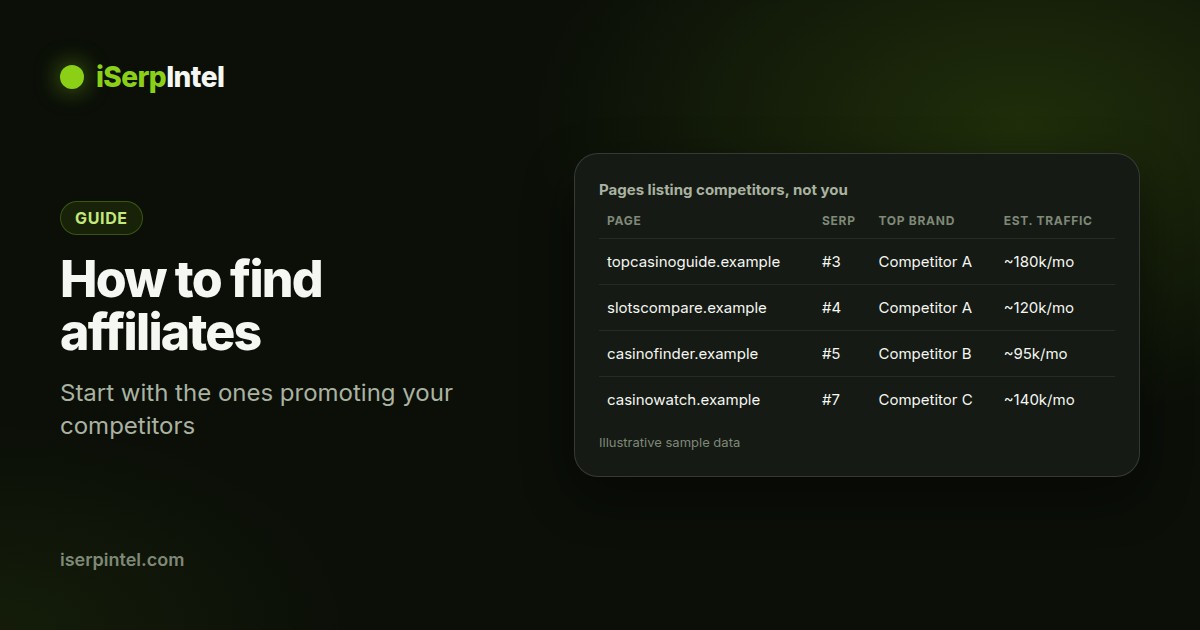
- Find them by searching your category keywords in each market, keeping the review pages that list competitors but not you, and ranking them by position and estimated traffic.
Where to find affiliates
- Affiliate networks. Networks and affiliate platforms let you list a programme and browse publishers. They're good for volume, but the best publishers get a lot of offers, so a listing alone rarely gets their attention.
- Your customers and community. Customers, partners and fans who already use your product often convert well, but they usually bring smaller audiences.
- Content creators. YouTube channels, newsletters, podcasts and social accounts in your niche.
- Search results. The sites ranking on Google for your category keywords: review sites, comparison sites and "best of" lists. They reach buyers at the moment of choosing.
- Your competitors' affiliates. The part of those sites that already promotes your competitors.
The last two overlap, and the overlap is where to start.
Why competitor affiliates come first
A site that ranks for your keywords and lists your competitors has already answered the questions you'd have about any cold prospect:
- It has the right audience: people searching for your category, in your market.
- It already works with brands like yours, so adding one more is a commercial conversation, not a pitch to enter a new category.
- Its value is measurable. You can see where it ranks and estimate its traffic before you contact it.
- The gap is visible. The page is sending readers to your competitors, and you're not on it.
How to find them, step by step
- List your category keywords. The searches buyers make before choosing: "best [category]", "[category] reviews", "top [category] [country]", "[competitor] alternatives".
- Search each keyword in each market. Use the right country setting and a private window. Results, and the affiliates that rank, differ a lot from one country to the next.
- Record the review and comparison pages in the top 20. Skip brands' own websites, news sites and forums.
- Open each page and note the brands it lists. Record whether your brand is there, and which competitors are.
- Keep the pages that list competitors but not you. That's your prospect list.
- Repeat regularly. New pages start ranking all the time and others drop out. A list from three months ago is already out of date.
| Page | Ranking | Top brand listed | Est. traffic |
|---|---|---|---|
| topcasinoguide | #3 | Competitor A | ~180k/mo |
| slotscompare | #4 | Competitor A | ~120k/mo |
| casinofinder | #5 | Competitor B | ~95k/mo |
| casinowatch | #7 | Competitor C | ~140k/mo |
How to prioritise prospects
You won't contact everyone at once. Put the list in order by:
- Ranking position. Higher-ranking pages get most of the clicks. A page at #3 is worth far more than one at #15.
- Estimated traffic. Multiply each keyword's search volume by a typical click-through rate for the page's position, then add up across the keywords it ranks for. It's rough, but good enough to rank pages against each other.
- Reach across keywords and markets. A site that ranks for several of your keywords is worth more than its single best page suggests.
- How many competitors it lists. A page listing three of your competitors is clearly open to your category.
- Fit. Check the site's quality and, in regulated markets, that it only promotes brands licensed where you operate.
How to approach them
- Find the right contact. Look for an "advertise", "partners" or "contact" page, the affiliate disclosure, or the site owner on LinkedIn.
- Be specific. Name the page and the keyword: "Your 'best online casinos UK' page ranks third and lists two of our competitors, but not us." It shows you've done the work.
- Lead with what's in it for them. A commission or revenue share, an exclusive offer for their readers, or strong conversion rates. Affiliates choose brands that earn them money.
- Make listing you easy. Send your logo, offer details, tracking links and any compliance requirements up front.
- Check that it happened. Once they agree, confirm your brand appears on the page, and that it stays there.
Frequently asked questions
How do I find affiliates for my brand?
Start with the keywords your customers search for. The affiliate sites ranking for them already have the traffic you want, and the ones listing your competitors already promote your category. iSerpIntel lists them for every keyword and market you track.
Do you provide affiliate contact details?
No. You get the page, its domain, its position on Google and the brands it lists. Reaching out is up to you.
How is the traffic figure calculated?
It's an estimate: the search volume of each tracked keyword a page ranks for, multiplied by a typical click-through rate for its position. Use it to decide which gaps to close first, not as an exact visitor count.
Can I use it for a market I'm not in yet?
Yes. Track any supported market to see which affiliates dominate it before you launch there.
How often does the list change?
Every week. New pages that start ranking appear after the next scan, and pages that add your brand drop off the list.