In short
- Competitive intelligence is the ongoing collection and analysis of information about your competitors and market, used to make decisions.
- Most competitive intelligence tools cover channels competitors control: their websites, pricing, ads, social posts and hiring.
- In affiliate-driven markets, many buyers compare brands on third-party review pages. Track four things there: where competitors are listed, where they outrank you, what they offer, and what changed.
What competitive intelligence covers
Competitive intelligence (CI) is the practice of gathering information about your competitors and market and turning it into decisions: what to charge, what to build, where to spend. The usual sources are:
- Websites and pricing pages: product changes, price moves, new messaging.
- Advertising: search ads, display and social ads, and estimated spend.
- Search rankings: the keywords competitors' own websites rank for.
- Social media and PR: announcements, campaigns and mentions.
- Reviews: what customers praise and complain about.
- Hiring: job ads that hint at new markets or products.
Competitive intelligence tools collect this automatically, so teams can watch for changes instead of checking by hand.
The channel most tools miss
Everything on that list is something competitors publish or pay for themselves. In affiliate-driven markets (casino and betting, trading, finance, insurance, software) many buyers first meet brands on third-party pages: "best of" lists, reviews and comparisons ranking on Google.
Competitors don't own those pages, but they compete hard on them: for a place on the list, for a higher position, and for the offer the page shows. A competitor can gain a lot of ground there without changing its website, its ads or its prices, so CI that watches websites and ads never sees it.
What to track on affiliate pages
1. Where competitors are listed
For each buying keyword in each market, record which of the ranking pages list each competitor. A competitor showing up on pages you're not on is the clearest sign of where it has relationships you don't.
2. Where they outrank you
On the pages that list you both, who's higher? Lists are read from the top, so a competitor two places above you on a high-traffic page can matter more than one extra placement somewhere else.
3. What they offer
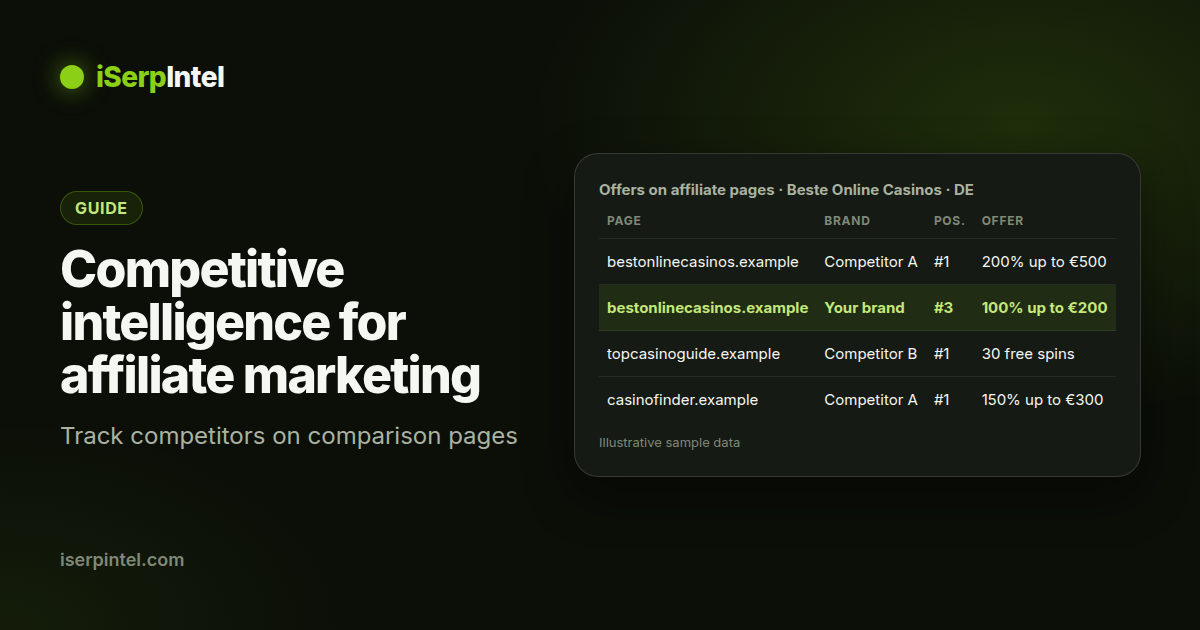
Affiliate pages show an offer next to each brand: a welcome bonus, a discount, a free trial, an interest rate. Tracking them shows which offers affiliates lead with, and when a competitor changes theirs.
| Page | Brand | Position | Offer |
|---|---|---|---|
| bestonlinecasinos | Competitor A | #1 | 200% up to €500 |
| bestonlinecasinos | Your brand | #3 | 100% up to €200 |
| topcasinoguide | Competitor B | #1 | 30 free spins, no deposit |
| casinofinder | Competitor A | #1 | 150% up to €300 |
4. What changed
Positions and offers move every week. Comparing this week with last week turns a static list into a signal. A competitor that jumps several places across many pages has usually improved its commercial terms or launched a campaign.
How to set up tracking
- Choose keywords that buyers use before picking a brand: "best", "top", "compare" and "review" searches for your category.
- Choose markets. Results differ by country and language, and so do the affiliates that rank. Track each country you sell in separately.
- Choose competitors. Start with the brands you lose customers to. Then add any brand that keeps appearing near the top of the lists: it's a competitor on these pages even if you don't think of it as a rival.
- Pick a cadence. Weekly is enough for most categories. Affiliate lists rarely change by the hour, but they do change within a month.
- Decide who acts on it. Affiliate managers use placements and positions for outreach and deal negotiations. Marketing and product teams use the offer changes.
By hand or with a tool
Checking by hand is the best way to get a first look at your category: search a keyword in the right country, open each review page, and note the brands, positions and offers.
It doesn't scale. Ten keywords in five markets means 50 sets of results and several hundred affiliate pages a week, each needing someone to read the list and record it the same way every time. Missed weeks also break the comparison over time.
A tool built for this channel does the collecting and keeps the history, so your time goes into acting on it.
Frequently asked questions
How is this different from other competitive-intelligence tools?
It covers one channel in depth: the affiliate, review and comparison pages ranking on Google. It doesn't track competitors' own websites, ads or social media.
Which competitors can I track?
Any brand listed on the pages we scan. Compare up to 10 of them at a time against your own brand.
Where does the offer data come from?
From the affiliate pages themselves. During each weekly scan we record the offer, rating and promo link shown for every brand on every tracked page.
Which markets can I track?
Any keyword in any of the markets we support. Plans are priced by the number of keyword-market pairs, and the free tier lets you try one from a predefined set.
How often is it updated?
Every week. Each scan is reviewed before it reaches your dashboard, and Rank Movement shows what changed since the previous one.